Deployment: Security Overview
This document outlines the security features implemented across the MobileForge platform to ensure data protection at every stage — from data collection on the device, through transit, to storage and access on the backend infrastructure.
Security Architecture Overview
MobileForge is deployed as an on-premise solution within the client's own cloud environment (AWS/GCP/Azure) or on-premise data centres. This ensures that all user data remains within the client's infrastructure boundary and never leaves their controlled environment.
The platform implements a defence-in-depth strategy with security controls applied at the following layers:
- SDK Authentication
- Data Privacy (On-Device PII Masking)
- Transport Security
- Data Compression
- Storage Encryption
- Network Isolation & Access Control
SDK Authentication
The SDK is embedded within the client's mobile application and initialised with a client_id, auth_token, and a backend_host_url pointing to the application servers deployed in the client's premises.
Token Encryption Mechanism
- The SDK encrypts the authentication token using AES-128 bit encryption with a randomly generated salt before every API call.
- Due to the random salt, a unique encrypted token value is generated for each request — ensuring no two API calls carry the same token payload.
- The backend validates the incoming encrypted token by decrypting and matching it against the original token stored in the database.
- The original plaintext token never travels over the network, eliminating the risk of token interception or replay attacks.
Unauthorized Request Logging
- All requests that fail authentication are logged in a dedicated
unauthorized_requeststable for audit and monitoring purposes.
Data Privacy: On-Device PII Masking
Before any data leaves the user's device, the SDK performs on-device masking of all Personally Identifiable Information (PII). This ensures that sensitive user data is never transmitted to or stored on the backend servers.
Additionally, no user data travels out of the client's premises. The backend servers do not communicate any user or business data to external systems. The only outbound communication from these servers to the outside world is limited to:
- Credeau's Auth API — for usage reporting and health metrics.
- Credeau's Content Delivery Networks — for fetching encrypted artifacts (models, configurations) required by the application services to function. These artifacts are regularly updated by Credeau's team on a weekly/bi-weekly cadence to keep the system current with the latest improvements.
Masked Data Categories
| Category | Examples |
|---|---|
| Names | Full names, first/last names |
| Phone Numbers | Mobile numbers, contact numbers |
| Identity Documents | Aadhaar numbers, PAN numbers, Voter ID, Passport numbers |
| OTPs | One-Time Passwords from SMS |
| URLs & Links | Hyperlinks embedded in messages |
| Email Addresses | Personal and business email IDs |
| Financial Identifiers | Account numbers, UPI IDs |
The masking is performed locally on the device before data is prepared for sync, ensuring that PII data is never transmitted over the network or stored in any backend database.
Transport Security
All communication between the SDK and backend services is secured using industry-standard transport layer encryption.
TLS Configuration
- All API endpoints are exposed exclusively over HTTPS.
- Minimum supported protocol version: TLS 1.2 (or greater).
- Ensures protection against eavesdropping, man-in-the-middle attacks, and data tampering during transit.
- To enforce all the above measures, the SDK is configured to reject endpoints that are non-secure (plain HTTP), resolve to private IP ranges (e.g.,
10.x.x.x,192.168.x.x), point to localhost addresses (127.0.0.1), or attempt HTTP redirects to a different host — preventing SSRF and DNS rebinding class attacks.
Data Compression
To optimise network utilisation and reduce bandwidth consumption, the SDK applies gzip compression on all data payloads before transmission.
Benefits
- Reduced network load and faster sync times.
- Lower data transfer costs for end users on metered connections.
- Minimised exposure window during data transit due to shorter transfer durations.
Storage Encryption (Encryption at Rest)
Once data enters the backend system, all persistent storage is protected with disk-level encryption.
Encryption Standard
- All database disks (MongoDB and PostgreSQL) are encrypted using AES-256 bit encryption.
- This applies to both managed database services (e.g., AWS DocumentDB, Amazon RDS) and self-hosted deployments.
- Encryption is applied at the storage volume level, ensuring all data — including indexes, logs, and temporary files — is protected.
Network Isolation & Access Control
MobileForge is designed with a strict network isolation model to minimise the attack surface.
Internal Services (Private Network)
The following components are deployed within private subnets (behind NAT gateways) and are not accessible from the public internet:
- Kafka Message Brokers
- Consumer Services
- MongoDB Databases
- PostgreSQL Databases
- SMS Extraction API
Publicly Accessible Services
Only the following endpoints are exposed to external networks:
| Service | Exposure | Access Control |
|---|---|---|
| Producer API (Data Sync) | Public | SDK communicates with this endpoint over the public internet from end-user devices; secured via token-based authentication (see SDK Authentication above) |
| Insights API | Public / Private | Client's backend servers call this API; can be hosted on a private network if the client's servers share network access, or exposed publicly with IP-based firewall rules |
Recommended Network Infrastructure
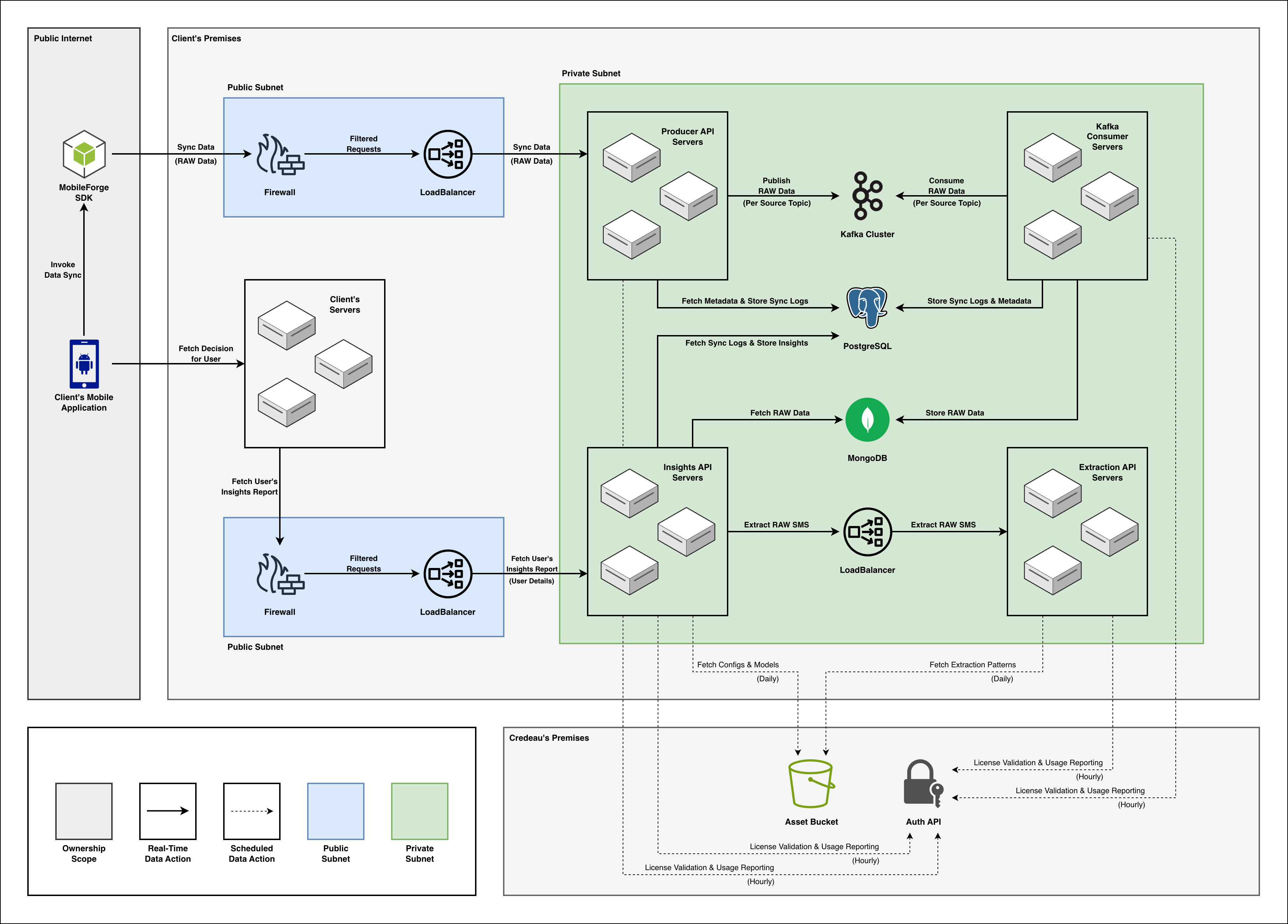
Security Assessments & Code Reviews
Vulnerability Assessment and Penetration Testing (VAPT)
- The platform undergoes regular VAPT assessments conducted by third-party CERT-In empanelled entities.
- These assessments are performed on a periodic basis to identify and remediate vulnerabilities across all deployed components.
- Findings are triaged, prioritised, and addressed before each release cycle.
Automated Security Scanning
- The product development lifecycle includes active security scans at the source code level to detect and address all recommended threats.
- These scans are integrated into the CI/CD pipeline as automated processes, ensuring that vulnerabilities are caught early — before code reaches production.
- Scans cover common threat categories including OWASP Top 10, dependency vulnerabilities, and static code analysis findings.
Security Summary
| Layer | Mechanism | Standard |
|---|---|---|
| Authentication | AES-encrypted token with random salt | AES-128 |
| Data Privacy | On-device PII masking before sync | — |
| Transport | HTTPS with TLS | TLS 1.2+ |
| Compression | Gzip compression on payloads | — |
| Storage | Disk-level encryption at rest | AES-256 |
| Network | Private subnets, NAT, IP allowlisting | — |
| Access Control | Firewall rules, Security Groups | — |
Compliance Considerations
- Data Residency: All data remains within the client's infrastructure boundary. No data is transmitted to external servers.
- Audit Logging: All API requests (both authorised and unauthorised) are logged with timestamps, client identifiers, and request metadata for audit trail purposes.
- Credential Management: Authentication tokens and database credentials should be managed using secret management services (e.g., AWS Secrets Manager, HashiCorp Vault) and rotated periodically.