CredForge Components
CredForge is built on two primary components - the Config Manager and the Core APIs, each composed of modular services that can be independently scaled and deployed.
Core APIs
Exposes core APIs that orchestrate the decisioning workflow by integrating workflow management, rules processing, feature computation, and external system connectivity.
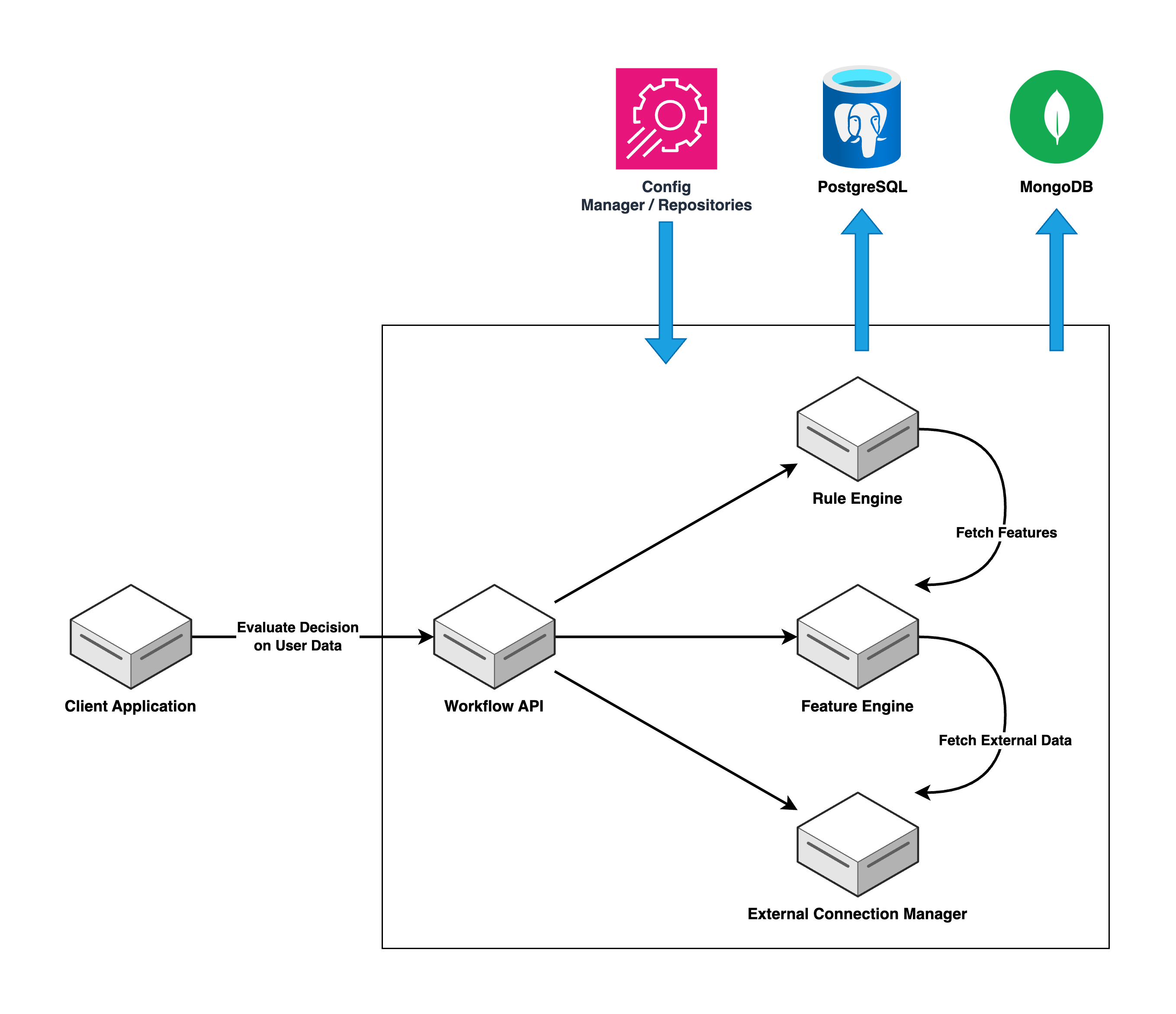
Components:
-
Workflow Manager: Orchestrates the decisioning process by executing predefined workflows against user input variables, ensuring proper sequencing and state management.
-
Rule Engine: Evaluates business rules and conditions through a configurable decision tree, enabling complex decision logic and policy enforcement.
-
Feature Engine: Processes input variables through configurable feature computation pipelines, transforming raw data into meaningful decisioning features.
-
External Connection Manager: Manages and orchestrates integrations with external services through configurable connection profiles and metadata-driven configurations.
-
Databases:
- MongoDB: Document database for storing system configurations, workflow definitions, rule sets, and integration metadata across all core decisioning components.
- PostgreSQL: Relational database for managing transactional data, audit trails, and application logs with robust data integrity and query capabilities.
Config Manager
Responsible for orchestrating and managing the core decisioning components including workflow configuration, rules engine, feature computation engine, and external system integrations.
Components:
-
Admin Portal UI: Provides an intuitive web interface for administrators to manage system configurations, monitor workflows, and control decisioning parameters.
-
Admin Portal Backend: Exposes RESTful APIs to handle configuration management, export settings, and maintain system state across the decisioning platform.
-
Databases:
- MongoDB: Document database for storing versioned configurations, system metadata, and portal settings with support for configuration history and rollback capabilities.
Each component is designed to be modular, allowing independent scaling, deployment, and monitoring depending on workload or use-case.